Enterprise AI Private Knowledge Base
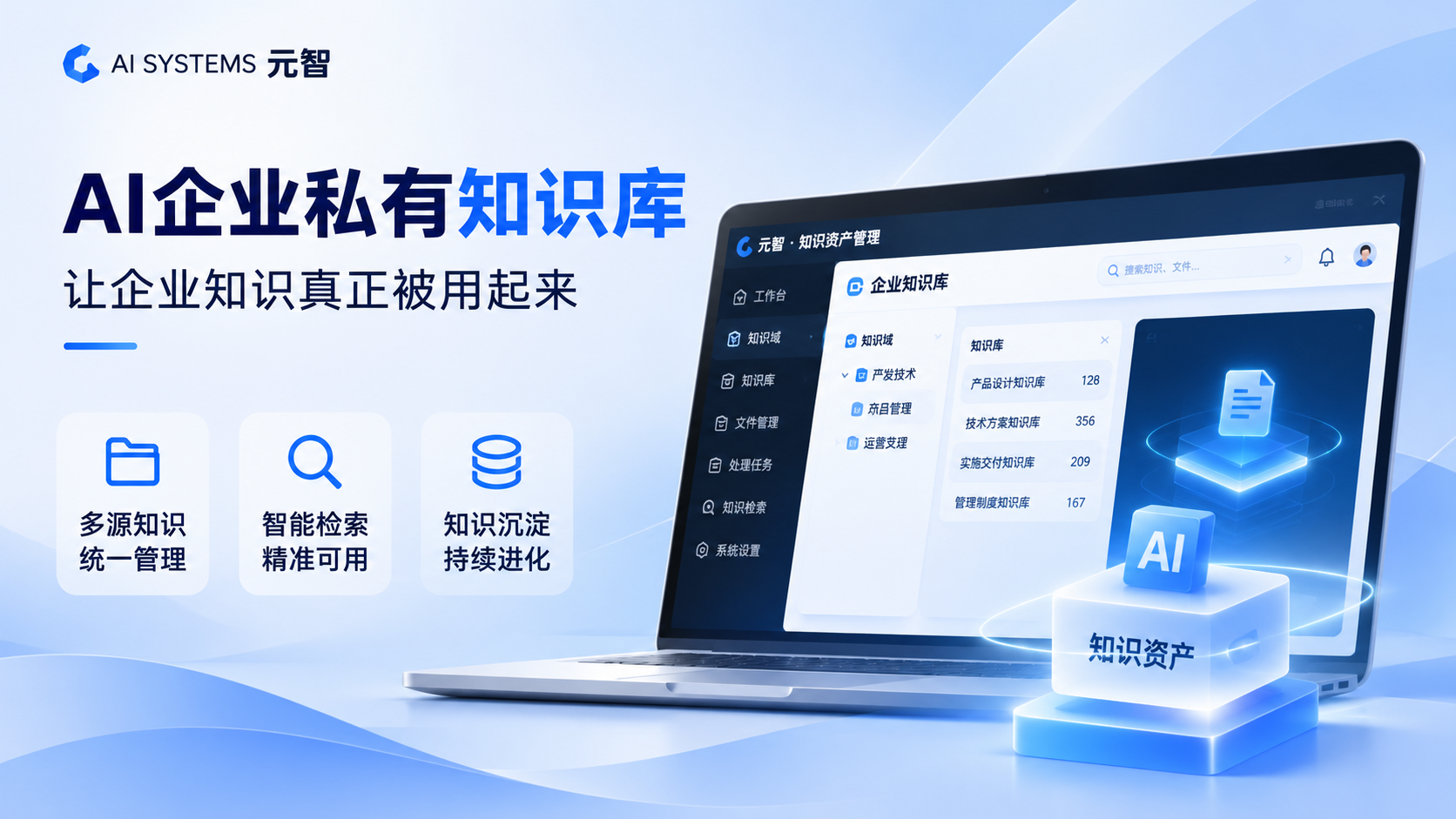
Yuanzhi is a knowledge asset management system designed for enterprise knowledge consolidation and AI applications. By centrally managing corporate documents, professional expertise, and business knowledge, it establishes a structured knowledge asset framework that transforms scattered information into manageable, searchable, and reusable digital assets, providing a continuously evolving knowledge foundation for enterprise AI implementations.
Core Capabilities
- Unified multi-source knowledge management
- Precision intelligent retrieval
- Continuous knowledge evolution
Highlights
- Three-tier knowledge tree management (knowledge domains > knowledge bases > files)
- Centralized organization of corporate documents and professional knowledge assets
- Supports file uploads, status tracking, and knowledge governance
- Decoupled client-side management and server-side processing
- Extensible architecture for RAG retrieval and multi-AI application knowledge reuse
Business Value
Resolves issues of fragmented knowledge storage and redundant organization, transforming professional materials into unified knowledge assets.
Reduces employee effort in locating and utilizing internal knowledge, improving conditions for knowledge sharing and experience transfer. Decreases reliance on individual employees for critical knowledge, supporting role transitions, talent development, and organizational learning. Provides a sustainably maintained knowledge foundation for future AI-powered retrieval, expert assistants, and business agent development.
Case Details
Yuanzhi | Enterprise AI Private Knowledge Base
1. Project Background
Enterprises accumulate policies, business materials, project experience, methodologies, and employee knowledge over time. However, this content often remains scattered across folders, systems, and personal devices without unified organization.
While knowledge exists, it frequently cannot be quickly located, effectively utilized, or systematically accumulated. As enterprise AI adoption deepens, knowledge management faces new requirements: enabling both human and AI systems to access knowledge within defined permissions and governance boundaries.
Yuanzhi addresses these needs as an enterprise knowledge asset management system.
2. Product Positioning
Yuanzhi focuses not just on file storage, but on knowledge asset organization, processing, management, and reuse. The system establishes sustainable knowledge infrastructure through unified management structures and service interfaces, with the core objective of transforming dispersed enterprise knowledge into continuously manageable digital assets.
3. Core Capabilities
3.1 Three-Tier Knowledge Asset Management
Organizes knowledge via "Domain > Base > File" hierarchy:
- Domains: Group knowledge by professional field or business scope
- Bases: Create thematic, operational, or application-specific collections
- Files: Manage source documents with metadata and processing status
Reduces management complexity through clear taxonomy.
3.2 Multi-Source File Management
Provides unified import and processing for corporate documents and knowledge materials, featuring:
- File uploads
- Document listings
- Detailed views
- Status tracking
- Deletion controls
Serves as single point of entry for knowledge refinement.
3.3 Knowledge Processing & Intelligent Retrieval Architecture
Implements AI-ready processing pipeline:
Document parsing → Text cleansing → Knowledge chunking → Embedding vectorization → Vector retrieval
Leverages RAG architecture to enable AI applications to generate business-contextual responses. Capabilities are versioned, with roadmap features clearly distinguished from delivered functionality.
3.4 Decoupled Knowledge Management & AI Applications
Architecture separates:
- Client-side: Asset management, file uploads, status monitoring
- Server-side: Knowledge processing, data storage, AI services
Enables unified governance while supporting cross-application knowledge reuse.
4. Technical Architecture
Client: Electron, React, TypeScript
Server: Python, FastAPI
Database: PostgreSQL
Planned vector search: pgvector
Knowledge processing pipeline: Parsing, cleansing, chunking, embedding, RAG
File storage: Local server storage with extensibility
System layers knowledge asset management above business agents, workflows, and prompt logic to avoid tight coupling with specific AI applications.
5. Business Value
Simplifies knowledge governance through unified taxonomy and file management, addressing fragmentation issues.
Enables continuous experience accumulation by providing structured repositories for professional materials and operational knowledge.
Supports diverse business applications through future-ready knowledge processing and retrieval capabilities.
Transforms knowledge management from ad-hoc documentation into maintainable, extensible infrastructure for AI applications.
6. Implementation Insights
Yuanzhi prioritizes solving fundamental challenges in knowledge organization, management, accumulation, and multi-AI reuse—rather than simply adding AI chat interfaces. Its evolutionary path begins with asset management, then progressively builds processing, retrieval, and AI service capabilities.
Ultimately, Yuanzhi makes enterprise knowledge actionable.
Case Media
09:46