AI Office Center
The AI Office Center is an AI application system centered on the X Extension Mechanism, designed for high-frequency enterprise office scenarios. Built upon three core agents—AI Writing, AI PPT Creation, and AI Meeting—it not only completes specific office tasks but also explores transforming recurring enterprise demands into auditable, manageable, and reusable AI capabilities. Currently, the X Extension Mechanism is primarily applied in the AI Writing Agent, evolving office AI from fixed-function tools into a continuously accumulating competency system.
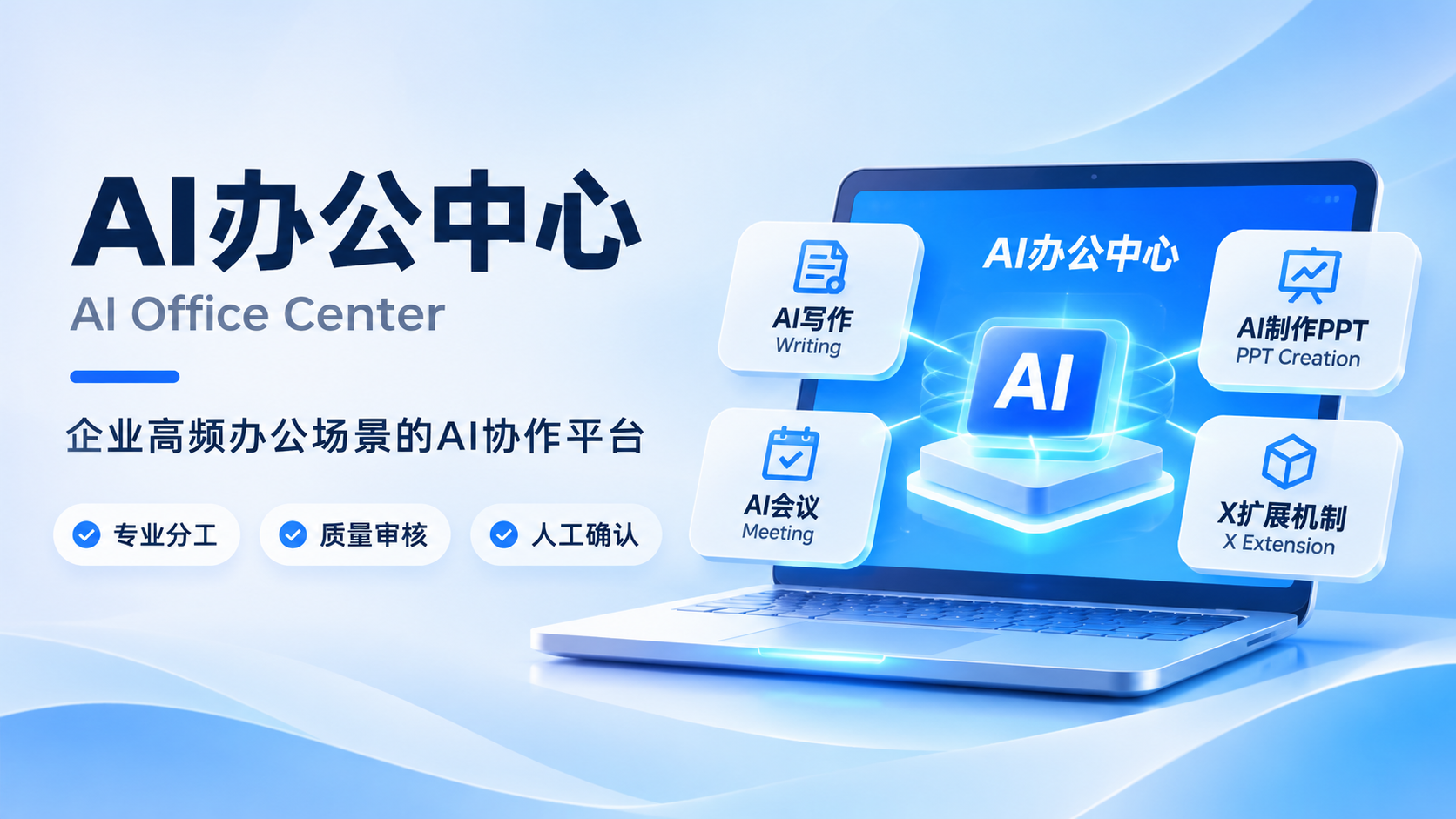
Core Capabilities
- X Extension Mechanism & AI Capability Accumulation
- AI Writing & Standard Document Generation
- AI PPT Creation & Meeting Management
Highlights
- X Extension Mechanism: Identifies new demands, audits existing capabilities, and builds reusable competencies
- Transforms one-off office tasks into sustained enterprise AI capability development
- Currently operational in the AI Writing Agent
- Supports five standardized document types: official documents, policies, reports, emails, and contracts
- AI PPT Creation employs S/A/B grading and outline-first principles
- AI Meeting follows a nine-step workflow with manual confirmation at key nodes
- Combines professional specialization, independent quality audits, and human validation
Business Value
Continuous response to emerging needs: The X Extension Mechanism identifies, analyzes, and builds capabilities for evolving office demands, reducing reliance on preconfigured static functions. Reduced redundant development costs: Capability deduplication and reuse minimize repetitive builds for similar needs, enabling progressive accumulation of reusable AI assets. Organizational AI capability assets: Audited high-frequency office demands become managed, reusable competencies, shifting enterprises from one-time AI tools to sustained capability building. Enhanced daily office efficiency: Three core agents streamline document drafting, presentation creation, and meeting logistics by automating repetitive work. Controlled quality and governance: Professional workflows, independent audits, and manual checkpoints mitigate risks of unvetted AI outputs entering business processes. Gradual AI transformation: Starting with proven office scenarios (initially AI Writing), the X Extension Mechanism provides a scalable foundation for sustainable enterprise AI systems.
Case Details
AI Office Center | AI Office Center
Centered on the X Extension Mechanism for continuous enterprise AI capability growth.
I. Project Context: Enterprises Need More Than Isolated AI Tools
With advances in large language models and agent technologies, enterprises now apply AI to daily office scenarios like document drafting, presentation creation, and meeting management.
While these solutions address repetitive tasks, a critical challenge emerges: Enterprise office demands inevitably outgrow prebuilt functionalities.
Today's policy document may require tomorrow's business report; current presentation needs may evolve into new data processing and collaboration demands.
If every new demand triggers fresh agent development and workflow reconfiguration, enterprise AI risks endless build-maintain cycles.
Crucially, without institutionalizing solved problems and methods, similar future demands will require redundant investments.
Thus, the AI Office Center addresses two foundational questions from inception:
1. How can AI solve current high-frequency, well-defined office tasks?
2. How can emerging needs systematically transform into reusable AI capabilities?
Specialized agents answer the first; the X Extension Mechanism tackles the second.
II. Product Vision: From Static Tools to Extensible AI Capability Systems
The AI Office Center is an AI collaboration system for high-frequency enterprise scenarios.
Built on three core agents (AI Writing, AI PPT Creation, AI Meeting) and the X Extension Mechanism, it transforms recurring demands into managed, auditable, reusable AI capabilities.
System architecture:
- AI Writing Agent: Standardized document generation
- AI PPT Creation Agent: Presentation planning and production
- AI Meeting Agent: Meeting coordination, minutes, and action tracking
- X Extension Mechanism: Identifies and processes eligible new demands to drive capability accumulation
While the first three agents address known pain points, the X Mechanism enables organic AI evolution alongside real-world needs.
The long-term goal isn't proliferating standalone tools, but building an enterprise AI system that continuously grows professional competencies.
III. Core Innovation: The X Extension Mechanism
1. Why It's Needed
Traditional AI applications develop against predefined requirements.
Once built, systems execute fixed tasks but struggle with novel demands—each requiring technical redevelopment, perpetuating response delays and maintenance burdens.
The X Mechanism changes this paradigm.
Rather than letting LLMs freely generate tools, it governs new demand processing through:
- Identification
- Classification
- Deduplication
- Capability building
- Quality audits
- Human confirmation
Its goal: Systematically convert eligible recurring needs into enterprise-ready AI capabilities.
2. Demand Identification & Classification
Not all user requests warrant new capabilities. The system categorizes demands as:
A: Solvable by existing capabilities (direct reuse)
B: Recurring value candidates (enter X Mechanism pipeline)
C: One-off tasks (ad-hoc solutions)
D: Custom development needs (separate evaluation)
This prevents capability bloat and maintenance overhead.
3. Capability Building Workflow
For qualified demands, the X Mechanism executes controlled capability development:
Step 1: Demand clarification
Step 2: Capability deduplication
Step 3: Capability construction
Step 4: Quality audit
Step 5: Human confirmation
Step 6: Capability institutionalization
This links demand processing with enterprise asset accumulation.
4. Core Value Proposition
The X Mechanism delivers more than task expansion—it establishes sustainable capability development:
- From redundant builds to capability reuse
- From one-off tasks to lasting competency assets
- From uncontrolled generation to governed extension
- From static functions to organic evolution
5. Current Scope & Boundaries
The X Mechanism currently operates primarily within the AI Writing Agent.
AI PPT and Meeting Agents remain focused on preconfigured capabilities.
Crucially, the system maintains governance boundaries—all new capabilities require eligibility checks, quality audits, and human confirmation before deployment.
IV. Three Core Agents: Solving High-Frequency Office Needs
The X Mechanism requires real-world applications to extend. Thus, the system first delivers three specialized agents:
1. AI Writing Agent
Professionalizes standardized document production across five types:
- Official documents
- Policies
- Reports
- Emails
- Contracts
Emphasizes structured workflows over raw text generation. Serves as primary X Mechanism testbed for new capability development.
2. AI PPT Creation Agent
Prioritizes content logic before visual design.
Implements S/A/B grading and mandatory outline approval to minimize iterative revisions. Includes independent checks for content integrity and logical flow.
3. AI Meeting Agent
Covers end-to-end meeting lifecycle across nine standardized steps with three human confirmation points:
- Scheduling
- Minutes
- Action items
Focuses on converting discussions into trackable execution.
V. Design Principles
1. Demand-Driven Capability Building
Prioritizes real pain points over agent quantity.
2. Specialization & Quality Control
Task-specific workflows with mandatory audits.
3. Human Oversight
Critical judgments and new capabilities require human confirmation.
4. Anti-Redundancy
Existing capability checks precede new builds.
5. Gradual Expansion
Proven-scenario-first approach, currently focused on AI Writing.
VI. Business Value: From Efficiency to Capability Accumulation
1. Continuous Demand Response
X Mechanism provides managed technical pathways for evolving needs.
2. Reduced Development Costs
Capability reuse minimizes redundant builds.
3. Organizational Asset Creation
Transforms solved problems into lasting enterprise competencies.
4. Operational Efficiency
Specialized agents streamline high-frequency office work.
5. Governance & Control
Structured processes ensure quality and accountability.
6. Foundation for Gradual AI Transformation
Starts with concrete needs, scales with validated success.
VII. Key Insight
The AI Office Center's value lies not in agent count, but in its X Extension Mechanism—enabling enterprise AI systems to grow alongside business needs through governed capability reuse. This shifts the paradigm from one-time task completion to sustainable competency accumulation, where solved problems become institutional assets for future challenges.
Case Media
03:58